
Purbasthali Sightseeing
Purbasthali is a birdwatcher’s paradise – Local and migratory birds. Purbasthali region is steeped in history and religion.
The crystal clear waters of the 9 km long channel of the Ox Bow Lake and the surrounding fruit orchards and farmlands harbour more than 70 species of local and migratory birds. Purbasthali is also a favourite to history buffs.
Sightseeing around Purbasthali
The crystal clear waters of the 9 km long channel of the Ox Bow Lake and the surrounding fruit orchards and farmlands harbour more than 70 species of local and migratory birds, which makes Purbasthali a birdwatcher’s paradise. Apart from this, the whole of Purbasthali region is steeped in history and religion. With towns like Nabadwip and Mayapur within 15 kms. and Sribati Terracotta temples and ruins of history’s landmark events scattered throughout the region, Purbasthali is also a favourite to history buffs. Also, do not forget to stopover at Natungram Village and witness the artisans at work creating some of the finest wooden dolls and models.
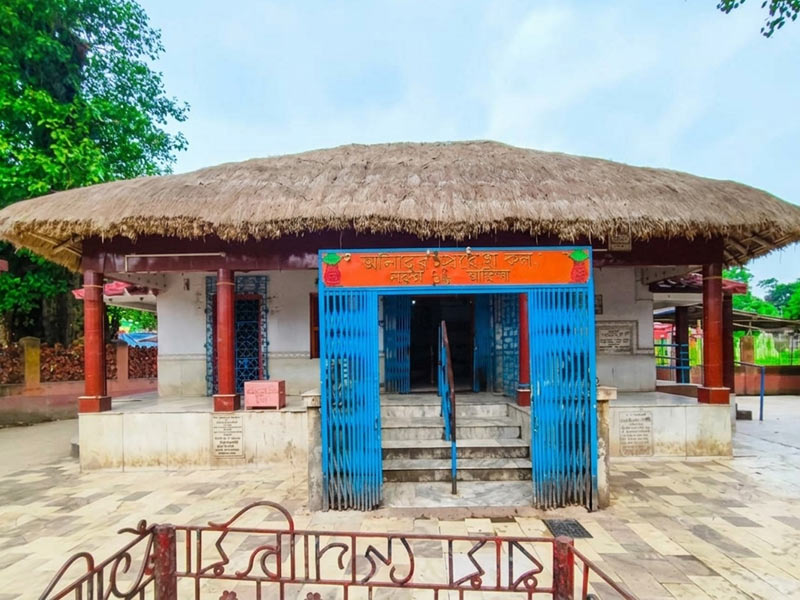
Baba Buro Raj Mandir – Jamalpur
Here, devotees worship the deities of Yama (Dharmaraja) and Lord Shiva (Buro Raja) together in a small temple with an appearance of a village hut with a thatched roof. Every year, during Buddha Purnima a huge fair is held in these premises where devotees bring their weapons to get it blessed.
Distance: Around 15 kilometers from Purbasthali.
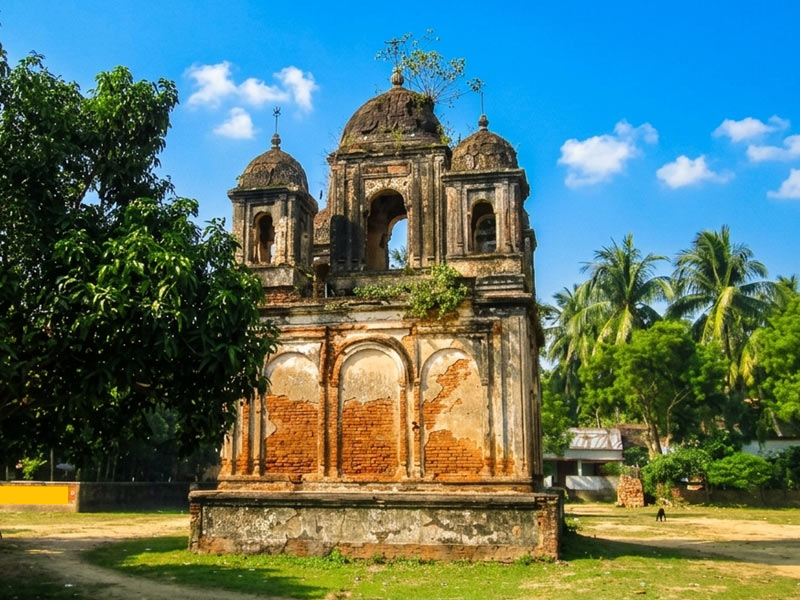
Chupi Char Gram
Apart from the winged visitors, the village of Chupi Char has also been home to some of the brightest minds of Bengal. Personalities like Akshay Kumar Datta (1820 AD to 1886 AD), Dewan Raghunath Roy (1750 AD to 1836 AD) and Dharmadas Mukhopadhyay were born in Chupi Village. Akshay Kumar Datta was the first Bengali writer to seriously work for the propagation of a modern scientific outlook, writing books on Physics and Geography in Bengali. The Tattwabodhini Patrika was published under his guidance, which was the mouthpiece of both the Tattwabodhini Sabha and Brahmo Samaj. His magnum opus was the two-part Bharatbarshiya Upasak Sampraday (Vol.1, 1871, Vol.2, 1883). The brilliant introductions to the two volumes of this book is proof to his profound philosophical, linguistic and scientific learning and depth. He was one of the initiators of the Bengal Renaissance. The renowned Bengali poet Satyendranath Dutta was his grandson. Another luminary to have adorned Chupi char Village is Dewan Raghunath Roy – the author of Shakta Padabali, which is now a standard reference for MA students of Literature in Calcutta University. The famous short-story writer and assistant editor of Yugantar Patrika was also born at Chupi.
Distance: Around 1 kilometer from Purbasthali.
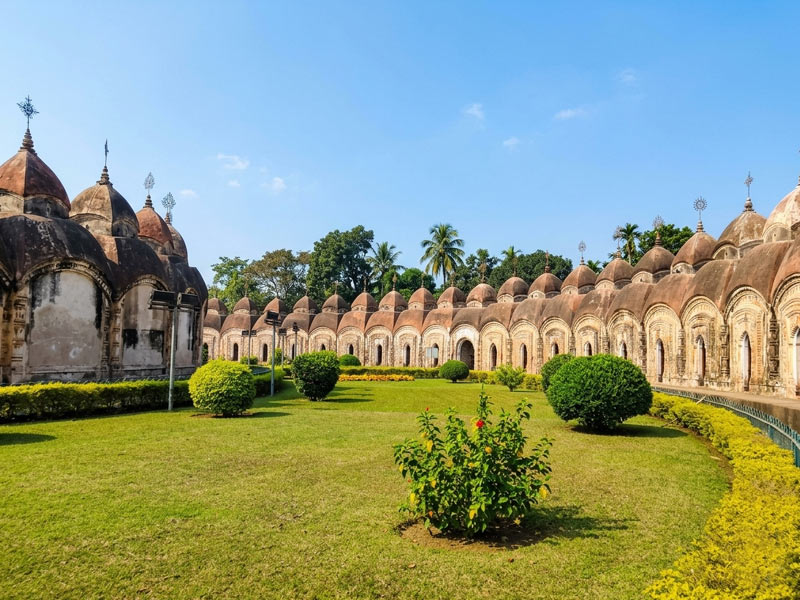
Kalna 108 Shiv Mandir
The temple town of Kalna or Ambika Kalna falls on the way to our resort. Some of the most distinctive and traditional temples of Bengal are located here with the most intricate terracotta carvings. If you are fond of temple architecture, then a visit to Rajbari Temple Complex of Kalna should be on your list. Amongst the many temples, the 108 Shi Mandir complex or Nava Kailash is the most popular. Built in 1809, these 108 temples were constructed in two circles. One consists of 74 temples while the other circle has 34. The other three temples famous for their terracotta carvings are Panchavimsatiratna (25 pinnacled) Lalji Mandir, Gopalbari and Krishnachandra Mandir. All these temples were built between 17th and mid 18th century by the Maharajas of Bardhaman.
Distance: Around 30 kms from Purbasthali.
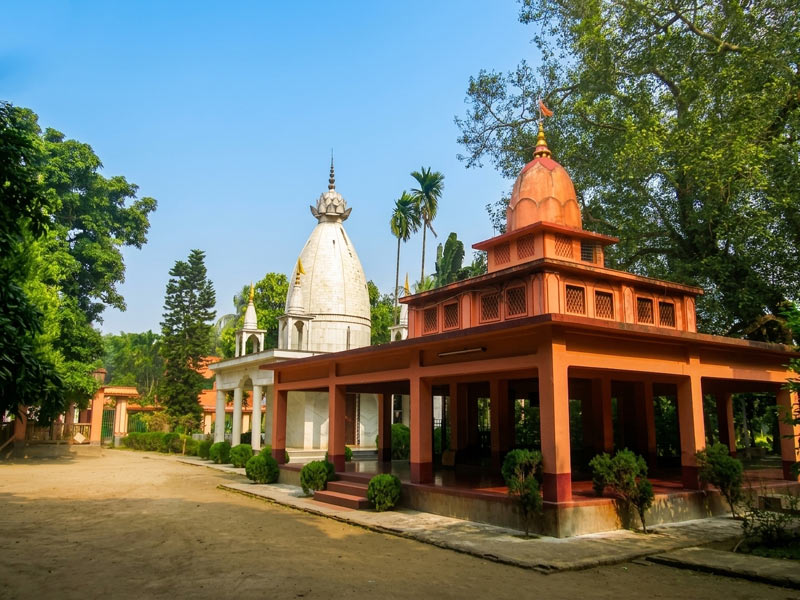
Kapil Muni Ashram
Very few people are aware of the existence of an ashram and original temple of Kapil Muni in Purbasthali. Located very near to our resort, the ashram is one of the earliest temples of Kapil Muni. The other two more famous ashrams of Kapil Muni are located in Sagar Island (Gangasagar) and Kolayat in Rajasthan. The Kapil Muni Temple of Purbasthali is a humble structure beside a serene Sarovar (lake), which is home to some of the largest freshwater catfish. The catfish are regularly fed and cared by the saints and pilgrims.
Distance: Around 8 kilometers from Purbasthali.
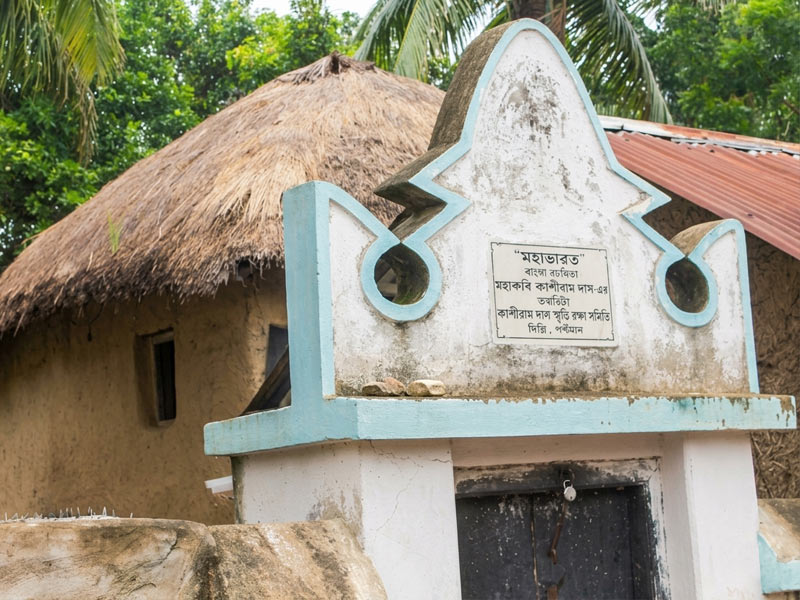
Kashiram Das Birthplace
Kashiram Das was an eminent sixteenth-century Bengali poet, celebrated for his monumental translation of the Mahabharata into the Bengali language. Born into a Kayastha Vaishnava family in Singi village (around 25 kms from Purbasthali Pakhiralay), he was the second son of Kamalakanta Das. His historical and cultural impact remains significant, as evidenced by the enduring local commemoration of his death anniversary. Composed approximately in 1610 AD, the Kashidasi Mahabharata is highly regarded for its employment of the traditional Panchali narrative style – a distinctive musical and oral tradition native to Bengal. Structurally, the epic is written in Payar Chhanda (Payar Metre), a metrical form central to classical Bengali poetry. The text holds a foundational position in the history of Bengali print culture; following the establishment of the Serampore Mission Press in the early nineteenth century, portions of the Kashidasi Mahabharata were among the earliest vernacular texts selected for publication.
Distance: 25 kms from Purbasthali.
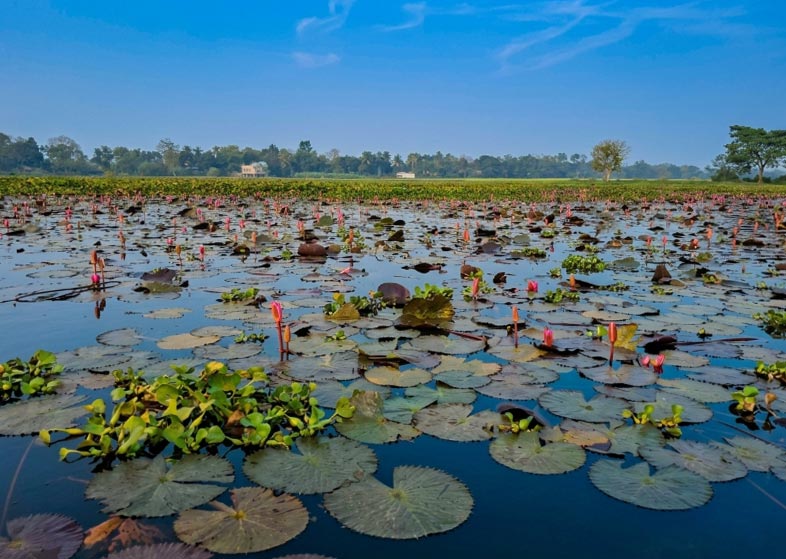
Koblar Beel
Koblar Beel (alternatively spelled as Koblaar Beel or Koblar Bil) is a ecologically significant oxbow lake and natural wetland spanning approximately 02 kilometers. Situated 04 kilometers from the historic temple town of Nabadwip, the lake has recently emerged as a prominent destination for low-impact ecotourism and conservation research. Like Purbasthali Lake, the wetland functions as a bird sanctuary, hosting diverse populations of both indigenous and migratory waterfowl. It serves as a vital breeding ground for specialized species, most notably the Pheasant-tailed Jacana, which nests within the floating macrophytic vegetation.
The unique topographical and vegetative conditions of the lake permit low-angle, unobstructed observation, making it a critical site for ornithological documentation and wildlife photography. The ecosystem is characterized by a high density of floating aquatic flora, dominated by various species of water lilies and lotuses. This dense vegetative canopy supports a complex, highly productive rural aquatic ecosystem, facilitating nutrient cycling and providing microhabitats that sustain local biodiversity.
Distance: 13 kms from Purbasthali.
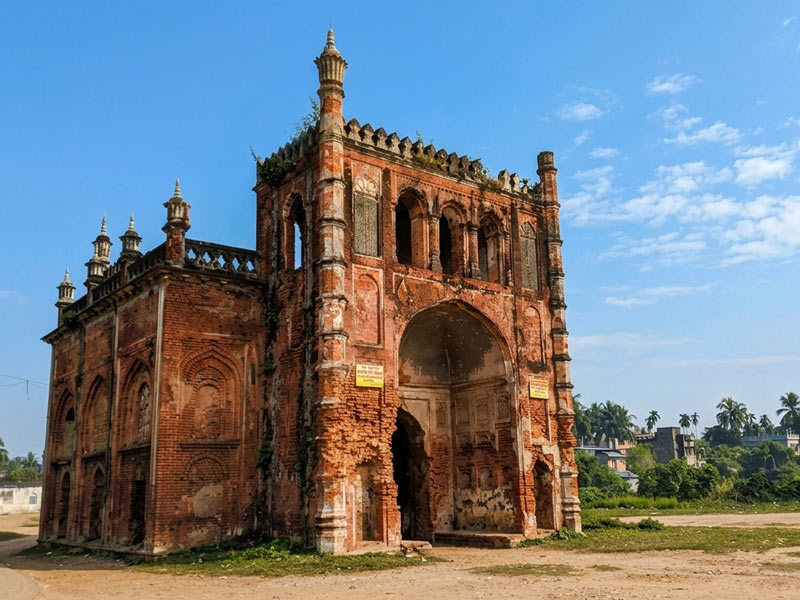
Krishnanagar
Krishnanagar, located on the southern banks of the Jalangi river was ruled by Raja Krishna Chandra Ray (1728 – 1782). Presently, the ruins of the Rajbari, its adjacent waterbody (Dighi) and the Durga Mandap are the main tourist attractions here. Few other attractions of Krishnanagar include Ghurni – the village of the famous doll makers and the Roman Catholic Church which hosts 27 oil paintings based on the life of Jesus Christ.
Distance: Around 30 kilometers from Purbasthali.
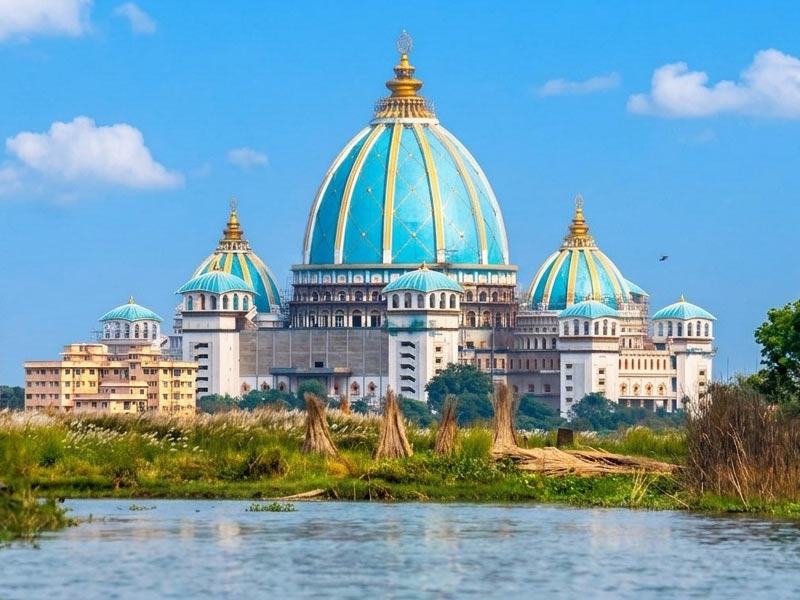
Mayapur
The Mayapur Temple Complex is just across our resort over the Ox-Bow Lake of Purbasthali. If you prefer a ferry ride, then drive for 15 kms to reach the Nabadwip Ghat and take a ferry to Mayapur. However, if you are taking your car and is reluctant to cross the river in a ferry, then you would have to tread for nearly 40 kms and cross river Ganges over Gouranga Setu to reach Mayapur. Located at the confluence of River Ganges and River Jalangi, Mayapur is the headquarters of International Society for Krishna Consciousness (ISKCON), which was founded by His Divine Grace A.C. Bhaktivedanta Swami (Srila Prabhupada) in 1966. The major attractions here are Srila Prabhupada’s Pushpa Samadhi Mandir, Sri Radha Madhava temple complex, the Goshala, which is a home of around 200 happy cows and the upcoming Temple of Vedi Planetarium.
Distance: Around 20 kilometers from Purbasthali.
Mertala
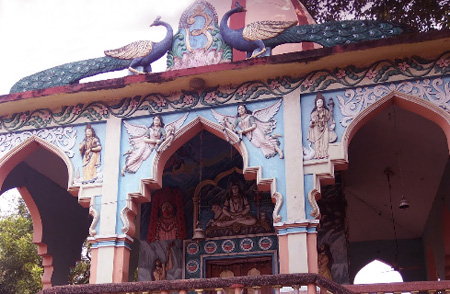
The mention of Mertala Village can be found in Krittibash Ramayan Panchali. Considered one of the most sacred Tantric Piths – Mertala is believed to have been a seat for human sacrifices in distant past. Home to a number of temples like Buro Shiv Mandir and Rajaram Gopal Mandir built during late 17th and early 18th century, this village also has a connection to Mantheshwar’s Chamunda Devi Mandir. However, Mertala village is also known to be the birthplace of the famous Bengali Film Actor Pahari Sanyal.
Distance: Around 7 kilometers from Purbasthali.
Nabadwip
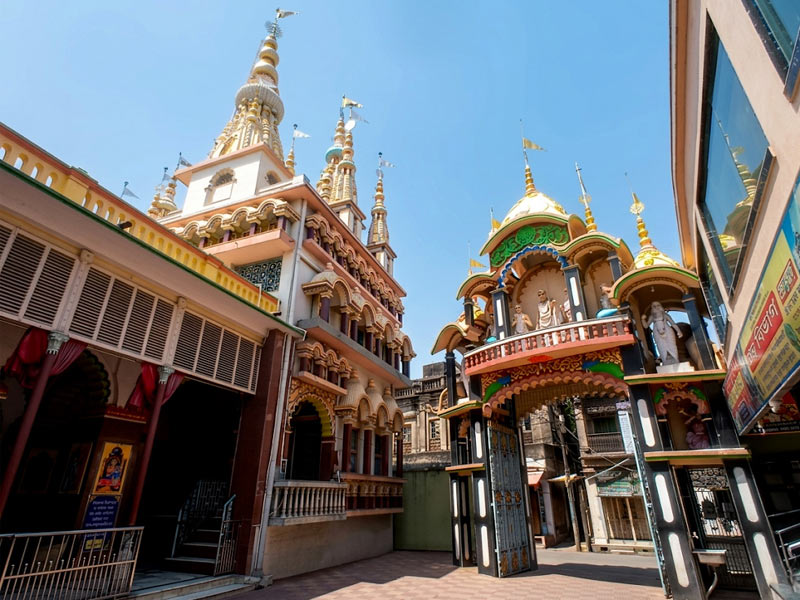
Nabadwip or the ‘new island’ served as the old capital of the Sena dynasty and is believed to have been founded in 1063 AD. It was a seat of learning in medieval India and is still revered for its “Tols” -traditional Sanskrit schools. The great social reformer and Vaishnava saint – Chaitanya Mahaprabhu (1486 AD to 1533 AD) and one of the most prominent figures of the Bhakti movement was born here. Nabadwip is an important center of pilgrimage for the Vaishnavas and Hindus world wide.
Distance: Around 13 kilometers from Purbasthali.
Natungram
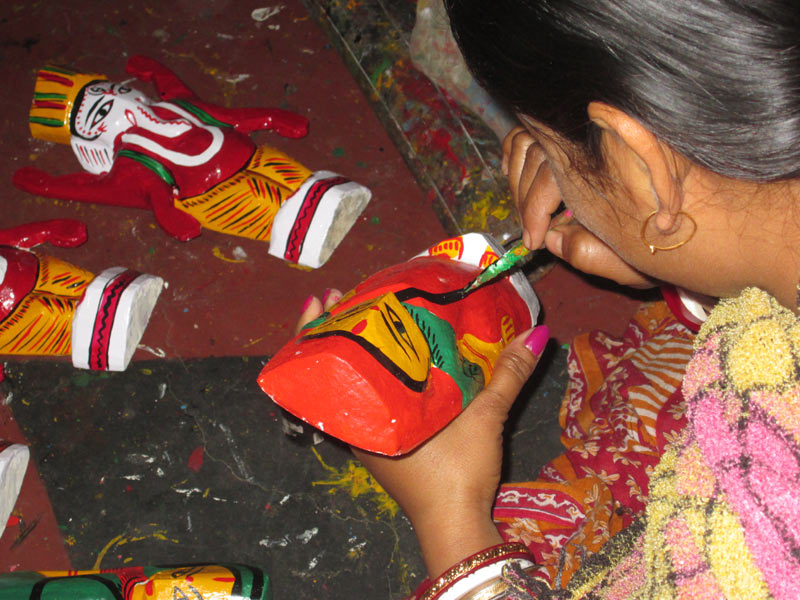
At Natungram, you would find all your favourite wooden dolls and household items decked with the most traditional designs of Bengal. Starting from stools to recliners to coffee tables and masks and idols of gods and goddesses – everything is handmade here. These wooden handicrafts are sold throughout India and they adorn the most exclusive lounges and lobbies.
The artisans of Natungram create the most fascinating and colourful wooden idols of Bengal. The traditional designs comprises elements from mythology and local folklore like Radha Krishna, Durga, Gour Nitai, Raja Rani and off course the owl. All idols are carved from one piece of wood. The artisans first draw the figures on blocks of wood and the figures are chiselled out and given the shape of the doll. The doll is then given a wash of Kharimati (soil), water, adhesive, flour and left to dry out. The colours are applied and the motifs are drawn by hand individually with fine brush strokes and final touch-ups are done before putting them up for display and sale.
Distance: Around 24 kilometers from Purbasthali.
Patuli
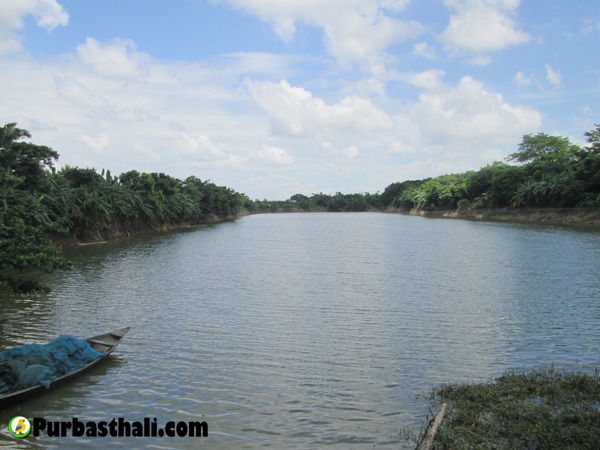
The Patuli village got its name from the Bengali word “Pat” which means jute. Still today jute cultivation is very popular in Patuli Village. This village also has a mention in the Vaishnav text of Chaitanya Charitamrita and presently some of its lost splendour can be seen in the dilapidated Dol Mancha and the ruins of Laxminarayan Mandir and Devi Siddheshwari Mandir. In 1656 AD, the Zamindari of Patuli was handed over to Raghav Roychowdhury by Mughal Emperor Shahjahan. Patuli has also been a stopover point of Robert Clive’s army in 1757 during the Battle Of Plassey.
Distance: Around 23 kilometers from Purbasthali.
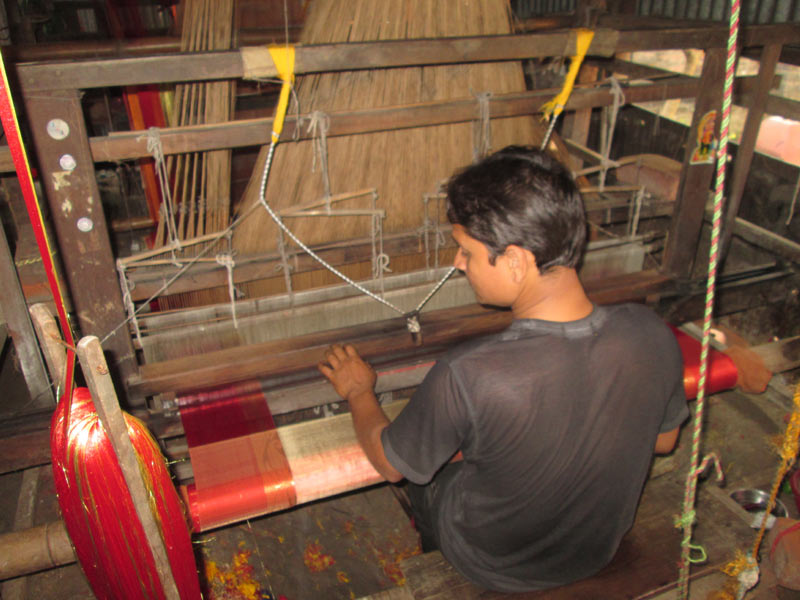
Samudragarh Handloom Workshops
Around 17 kms from our resort is the village of Samudragarh, where more than 10000 weavers design and weave some of the finest Tant (Handloom) sarees of India. There are Co-operatives which sell these finest quality handloom sarees to buyers. Most of it is sold to wholesalers located throughout India but individual buyers are also entertained nowadays. You can also visit the weavers home and workshpos and see them working on their looms and buy your favourite Jamdani, Tangail, Baluchari or Garad staright from the weaver.
Distance: Around 16 kilometers from Purbasthali.
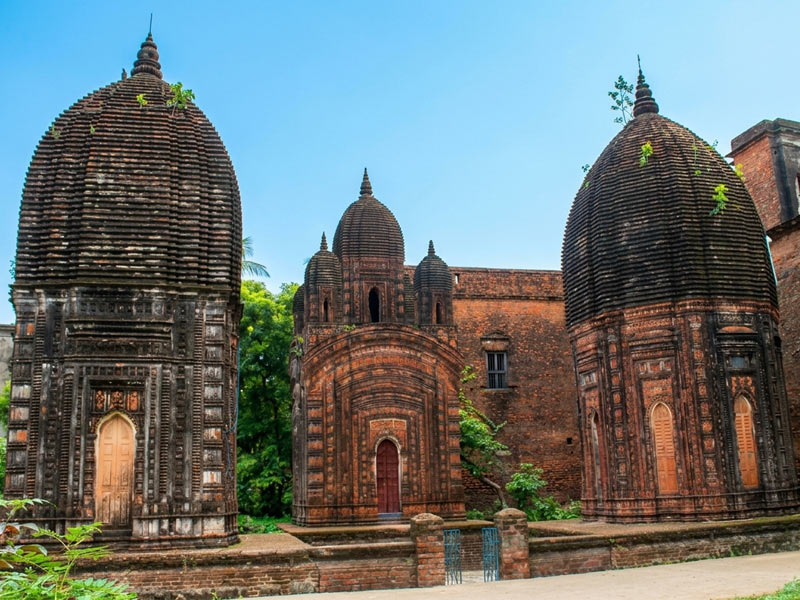
Sribati Terracotta Temples
The terracotta temples of Sribati are some of the finest specimens of terracotta temple architecture in India. Although most of the temples could not stand the test of time but few like the Shri Viswesara, Shri Bholanath and Shri Chandreswar still display the intricate terracotta panels with motifs of war scenes, boats with soldiers, various Gods and Goddesses and scenes from everyday life. All these temples were built by the Chandra Family who hailed from Gujarat around 1802 AD to 1836 AD. Some of the temples display the typical Bengal architecture of Rekh Deul while others even display the more popular Pancharatna style. The Sribati Terracotta Temple Complex is a State Protected Monument under the Archaeological Survey of India’s Kolkata circle.
Surrounding the temple complex are the 18th and 19th Century Zamindari mansions, in various states of preservation, displaying exquisite architectural motifs representative of the colonial era in Bengal – hanging balconies – open courtyards, , surrounded by up to three floors of living spaces. Many of the houses also contain a very high-ceilinged Puja Mandap or large hall on one side, with designs etched into the walls. One of the houses still hosts the annual Durga Puja, that has been held continuously for over 300 years.
Distance: Around 40 kilometers from Purbasthali.
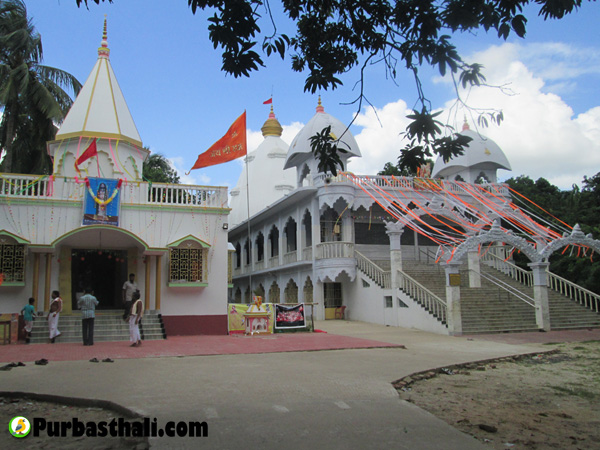
Swami Janaki Das Kathiababa Tapovan Ashram
Following the philosophy of Dwaitadwaitavaadi Vaishnava Vedanta, the Kathia Baba saints belongs to the sect of Nimbarka Vaishnav ascetics descending from the 15th century spiritual lineage of Sri Nagaji Maharaj. The term “Kathiababa” has risen from the usage of wooden (Kath means wood in Hindi and Bengali) chastity belts by the saints of this sect which are donned with the aim of subduing the lustful tendencies of the human body. The Swami Janaki Das Kathiababa Tapovan Ashram is located in a peaceful location beside the Nimbarka Sarovar in Patuli Village. The Ashram’s Charitable Trust supports two schools and the craft’s village of Natungram.
Distance: Around 24 kilometers from Purbasthali.

Want to book rooms. Get in touch now!
Address
Purbasthali Pakhiralay
Chupi-Kasthashali
Purba-Bardhaman, Pin - 713513
Phone/ WhatsApp
9073565723
(Mon-Sat, 11am to 7pm)